Relief Program• Updated: April 26, 2026

ADWC Punjab 2026 – Complete Guide to the Free Assistive Devices and Wheelchair Program

The ADWC Punjab program has been active and expanding its reach as of 2026. The Punjab Government has increased the annual budget allocation for assistive device distribution to cover more beneficiaries across previously underserved rural districts. The program has also improved its online registration system at adwc.punjab.gov.pk to make it easier for applicants to register without visiting a government office.

A key development in 2026 is the integration of ADWC registration with the NADRA disability database. This means that persons who already hold a disability certificate linked to their CNIC can complete the initial eligibility check online without needing to submit as many physical documents to the district office.

The program continues to receive applications on a rolling basis. There is no fixed annual deadline. Applications submitted at any point during the year are reviewed in the next available distribution cycle for the applicant's district.

For the most current information on active distribution cycles and registration windows, visit adwc.punjab.gov.pk or contact the Social Welfare Department helpline mentioned in Section 15.
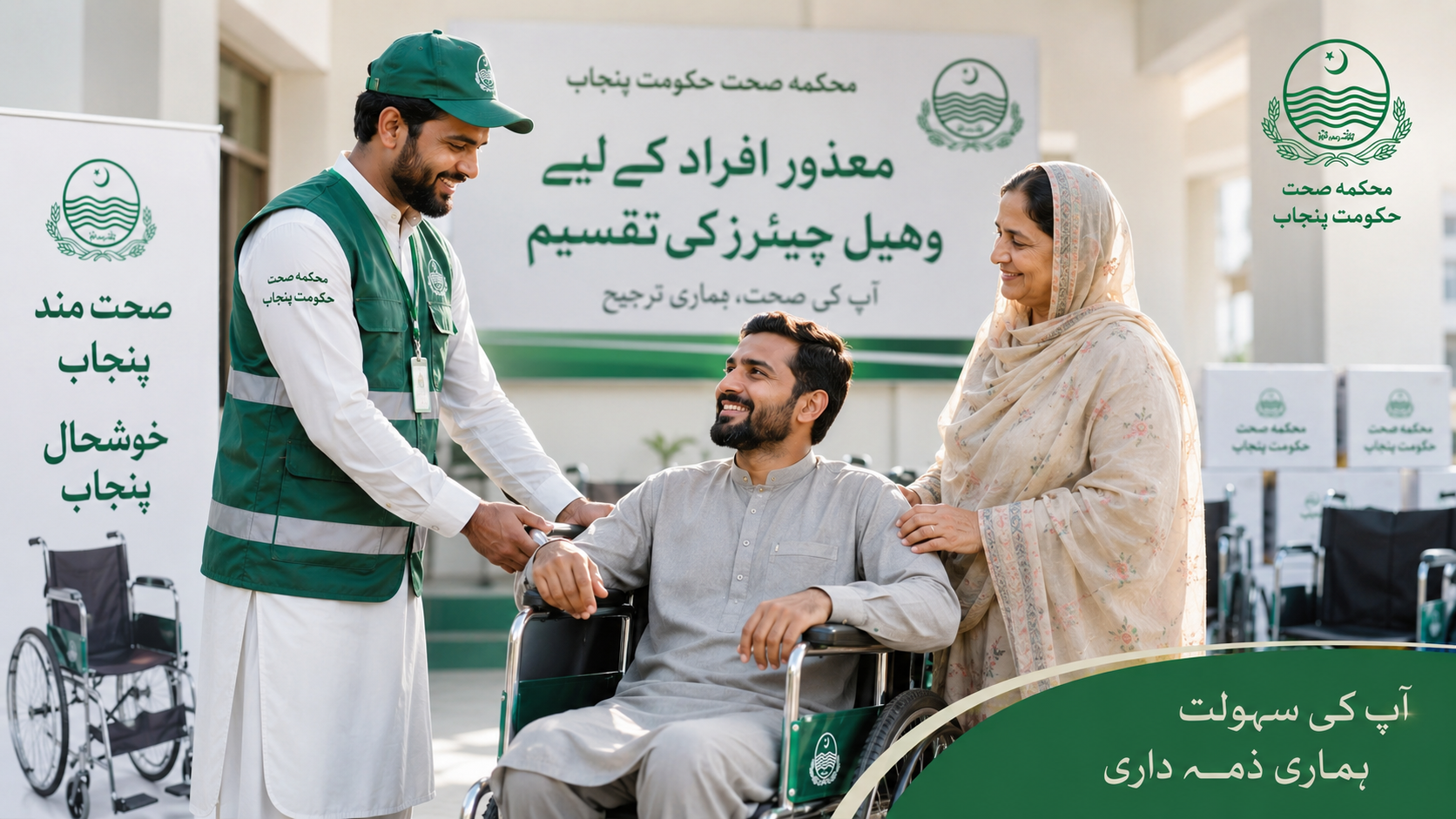
ADWC Punjab 2026 – Complete Guide to the Free Assistive Devices and Wheelchair Program hero graphic
Status

Active

Deadline

No Deadline

Benefit

Free Wheelchairs & Assistive Devices for Disabled Persons

Authority

Government of Punjab, Pakistan

ℹ️
Independent Informational Guide: This portal is a private, independent educational resource and is not affiliated with, authorized, or endorsed by the official Government of Punjab, Pakistan or any other government agency. Official registration links and portals are provided directly in our guides for reference.

What is ADWC Punjab 2026 – Complete Guide to the Free Assistive Devices and Wheelchair Program?

The Assistive Devices and Wheelchair Corporation Punjab, operating under the Social Welfare Department of the Government of Punjab, is a state-run body responsible for procuring and distributing assistive technology to persons with disabilities (PWDs) across the province. Its official portal is adwc.punjab.gov.pk and it falls under the administrative umbrella of the Directorate General Social Welfare Punjab.

The program was created in recognition of the fact that disability is not just a medical condition — it is also a social and economic challenge. A person who cannot walk without a wheelchair is not only dealing with a physical limitation but also with restricted access to education, employment, and basic public services. By providing the right device, the government aims to reduce dependence, restore mobility, and enable disabled individuals to participate more fully in society.

The ADWC does not sell devices. It provides them free of cost to eligible applicants who are registered as persons with disabilities and meet the income and residency criteria. Applications are assessed at the district level through the District Population Welfare Office and the Social Welfare Department before devices are approved and distributed.

Program Overview & Details

Under the ADWC Punjab 2026 – Complete Guide to the Free Assistive Devices and Wheelchair Program, the Government of Punjab provides targeted assistance to eligible residents across all 36 districts. Beneficiaries can register online through the official portal with a valid Nadra CNIC.

  • Coverage Area: All 36 Districts of Punjab, Pakistan
  • Verification Method: Nadra CNIC & Official Field Verification
  • Application Portal: Online Submission
  • Support Type: Government Financial & Social Subsidy

Eligibility Criteria & Requirements

  • Must be a permanent resident of Punjab holding a valid Nadra CNIC.
  • Must belong to an eligible household under Government of Punjab verification guidelines.
  • Must provide valid proof of residence and contact details.
  • CNIC must be active and verified through Nadra database.

Program Benefits

Key benefits of the ADWC Punjab 2026 – Complete Guide to the Free Assistive Devices and Wheelchair Program include direct government financial assistance, transparent online application tracking, zero hidden bank fees, and priority support for low-income households across Punjab.

How to Apply & Registration Guide

Follow these simple steps to apply online for ADWC Punjab 2026 – Complete Guide to the Free Assistive Devices and Wheelchair Program:

  1. Step 1: Visit the official government portal using the application link below.
  2. Step 2: Register an account using your valid 13-digit Nadra CNIC number.
  3. Step 3: Fill out the online registration form with personal and household details.
  4. Step 4: Submit your application and keep your tracking reference ID for verification updates.

Ready to Apply for ADWC Punjab 2026 – Complete Guide to the Free Assistive Devices and Wheelchair Program?

Visit the official Punjab Government portal to submit your online application.

Official Registration Portal

Important: Applicants must ensure their CNIC is not expired before applying. Verify your CNIC status at nadra.gov.pk before submitting your application.

Introduction

Types of Assistive Devices Provided

The ADWC Punjab program covers a wide range of assistive technologies depending on the type and severity of a person's disability. Understanding which device you or your family member needs is the first step before applying. Wheelchairs are the most requested item under the program. The ADWC provides both manual wheelchairs and, in cases of severe mobility impairment, motorized or electric wheelchairs. Manual wheelchairs are provided to individuals who have some upper body mobility, while motorized units are reserved for those with more complex disabilities who cannot self-propel. For persons with lower limb impairment or amputation, the program provides prosthetic legs and orthotic supports. These are custom-fitted devices, which means that after your application is approved, you will typically need to visit a fitting center rather than receive a standard off-the-shelf item. Persons with visual impairment can apply for white canes and, in some cases, braille kits and materials. The white cane is one of the most important mobility tools for a visually impaired person, and the program ensures it is available at no cost. Hearing aids are provided to persons with certified hearing loss. These are prescription devices, meaning a medical report from an ENT specialist or audiologist is a prerequisite. The ADWC does not provide hearing aids without a proper audiological assessment. Tricycles adapted for persons with lower limb disabilities are also distributed through the program. These are particularly valuable in rural areas where powered transport is unavailable, allowing disabled persons to travel independently within their communities. Crutches, walking frames, and other mobility support equipment are provided for temporary or permanent use depending on the applicant's condition. These are among the faster-processed items since they do not require the same level of custom fitting as prosthetics.

Who is Eligible for ADWC Punjab?

The ADWC Punjab program is open to registered persons with disabilities who are permanent residents of Punjab and who meet a set of criteria defined by the Social Welfare Department. The most important requirement is that the applicant must be a registered person with disability. This registration is done through the Disability Registration System linked to NADRA and the Social Welfare Department. A person is considered registered when they hold a valid disability certificate issued by a designated medical authority, typically a District Headquarters Hospital (DHQ) or Teaching Hospital, after a formal medical assessment. The applicant must be a permanent resident of Punjab with a valid CNIC showing a Punjab address, or a B-Form in the case of children under 18. The program does not serve residents of other provinces even if they are temporarily living in Punjab. There is no strict age limit for ADWC. Children, adults, and elderly persons are all eligible. However, applications for minors must be submitted by a parent or legal guardian, and the guardian's CNIC and a relationship proof document are required alongside the child's B-Form. Income eligibility is an important consideration. The ADWC program prioritizes applicants from low-income households. While the program does not publish a hard income cutoff figure, Social Welfare Department officers at the district level assess financial need as part of the application review process. Applicants who can demonstrate financial hardship are given priority in device allocation cycles. The applicant must not have already received the same type of device from the ADWC or any other government program within a specified period. Duplicate applications or previous beneficiaries attempting to obtain the same device again within the validity window will be deprioritized.

Required Documents

Before you visit a Social Welfare office or begin the online registration process, gather the following documents. Missing even one of these can delay your application significantly. The original and a photocopy of the applicant's CNIC is mandatory. For children under 18, the B-Form serves as the identity document. For adults without a CNIC due to their disability, a guardian's CNIC and a relationship affidavit may be accepted, but this varies by district and should be confirmed with the local office. A valid disability certificate is the most critical document. This is a medical certificate issued by a government hospital clearly stating the type and percentage of disability. The certificate must be issued by a recognized medical board or assessment committee at a DHQ, THQ, or Teaching Hospital. Private clinic certificates are generally not accepted. The certificate must be recent — most district offices will not accept a disability certificate that is more than two years old. A recent medical report or prescription supporting the specific device being requested is required in addition to the disability certificate. For hearing aids, an audiological test report from a certified audiologist is necessary. For prosthetics, surgical reports or orthopedic specialist notes are needed. For wheelchairs, a mobility assessment note from a doctor is helpful even if not always mandatory. Two recent passport-size photographs of the applicant are required. These must be clear and taken against a white background. A domicile certificate or a proof of Punjab residency is required. A utility bill in the applicant's or guardian's name showing a Punjab address is generally accepted as secondary proof. An income certificate or proof of financial need, issued by the local Patwari or a Union Council Nazim, helps in prioritizing the application under the financial need criterion. While not always mandatory, it significantly improves the chances of being selected in an early distribution cycle. In cases where the applicant is a minor or unable to manage the application independently, the guardian must provide their own CNIC, a relationship document such as a birth certificate or school record showing the parent-child link, and a simple written statement explaining that they are submitting the application on behalf of the disabled person.

How to Apply Online for ADWC Punjab

The online application route has become significantly more streamlined in 2026. Follow these steps carefully. Start by visiting the official ADWC portal at adwc.punjab.gov.pk. On the homepage, you will find a registration or application button. Click on it to begin the process. You will be asked to enter your CNIC number. The system will attempt to verify your identity through NADRA records. If your disability is already registered in the system, your basic details will auto-populate. If not, you will need to enter them manually. After identity verification, fill in the application form completely. The form asks for your full name, contact number, complete address including district and tehsil, type and nature of disability, device being requested, and details of the hospital where your disability certificate was issued. Once the form is filled, upload scanned copies of all required documents. Use a proper document scanner or a scanning app on your phone. Make sure each document is clear, fully visible, and not cropped at the edges. Upload failures are one of the most common reasons for application delays. After submitting, the system will generate a unique application reference number. Save this number immediately. It is the only way to track your application status later. Take a screenshot or write it down in a safe place. The application is then forwarded to the Social Welfare office in your district for review. From this point, the process moves offline and a field officer may be assigned to verify your information in some cases.

How to Apply Offline (In Person)

If you do not have internet access or face difficulty with the online portal, you can apply directly at the Social Welfare Department office in your district or at the office of the District Population Welfare Officer (DPWO). Go to the Social Welfare Department office in your district headquarters. Ask the reception officer specifically for the ADWC application form. Do not accept forms for other programs — make sure it is the ADWC assistive device form. Fill out the form completely and accurately. Every section must be filled. If a question does not apply to you, write "N/A." Do not leave any field blank. Take someone with you who can help if you have difficulty with reading or writing. Attach all required documents as listed in Section 6. Arrange the documents in the same order as they appear on the form's document checklist. Attach attested photocopies, not originals. Originals should only be brought for verification when the officer asks to see them. Submit the completed form to the designated officer. Ask for a receipt or acknowledgment slip stamped with the office seal. This receipt is your proof of application and contains the reference number you will need to follow up. Visit the office in person or call the district helpline within 4 to 6 weeks to ask about the processing status of your application if you have not heard back.

What Happens After You Apply

After your application is submitted — whether online or in person — it goes through a review process that most applicants are not fully aware of. Understanding this process can save you from unnecessary anxiety and repeated visits to the office. First, a designated Social Welfare officer at the district level reviews your application and documents for completeness. If anything is missing or unclear, your application is placed on hold and you may receive a call or a written notice asking for the missing document. Respond to this promptly, as applications on hold for more than 30 days without a response are typically archived. Once the documents are verified, your application goes to a district committee that meets periodically — usually monthly or quarterly — to review all pending applications and allocate available devices based on the program's current stock and budget. Priority is given to applications from persons with severe disabilities, children, women, elderly persons, and those from low-income backgrounds. If your application is approved in a distribution cycle, you or your guardian will receive a call or message from the district office asking you to collect the device or attend a fitting session in the case of prosthetics and hearing aids. Bring your original CNIC and the acknowledgment slip when you go to collect. If your application is placed in a waiting list, it does not mean rejection. It means the current cycle's allocation was full and your application carries over to the next cycle. This is common for high-demand devices like motorized wheelchairs and prosthetics.

How to Check Your ADWC Application Status

Once you have applied and received your reference number, there are two ways to track your application. Online status check is available at adwc.punjab.gov.pk. Log into your account using your CNIC and enter your reference number in the status check section. The system will show you whether your application is under review, approved, waiting for a distribution cycle, or on hold due to missing documents. For an offline status check, call the district Social Welfare office directly and provide your CNIC number and reference number. The officer can tell you exactly where in the process your application currently stands.

Benefits of the Program for Differently-Abled Persons

The ADWC Punjab program does more than provide a physical device. It represents a broader commitment by the Punjab Government to include disabled persons in everyday social and economic life. A wheelchair or a pair of crutches allows a person to attend school, go to work, visit a hospital, or attend a family event. Without it, many disabled individuals are effectively confined to their homes. The psychological impact of regaining mobility or hearing or vision clarity cannot be overstated. The program also reduces the financial pressure on families who have been spending significant portions of their income on renting or borrowing assistive devices. By receiving a government-provided device, a family's resources can be redirected toward education, nutrition, or housing. For women with disabilities in particular, the program addresses a compounded vulnerability. A disabled woman who cannot move independently is at higher risk of isolation, neglect, and dependence on others for basic needs. A wheelchair or prosthetic limb restores a degree of autonomy that has profound long-term effects on her health and wellbeing.

Common Challenges and How to Handle Them

Many applicants experience delays or rejections not because they are ineligible but because of avoidable procedural errors. The most common of these is a disability certificate from a private clinic or an expired certificate. Always obtain your disability certificate from a government DHQ or Teaching Hospital, and make sure it is not more than two years old at the time of application. Another frequent challenge is the income certificate. Many applicants skip this document because they assume it is optional. While it is not mandatory in every district, districts with high application volumes use the income certificate to prioritize allocation. Not having one can push your application several cycles down the waiting list. Some applicants apply for a device that does not match their certified disability type. For example, someone with a certified visual impairment applying for a wheelchair will face a mismatch that slows processing. Make sure the device you request is clearly supported by your medical documents. Phone number errors in the application form cause a significant number of applicants to miss their collection notification. Double-check the phone number you enter and make sure it is an active number that you or your guardian checks regularly.

Frequently Asked Questions (FAQs)

Share your thoughts about this scheme

Share your opinion, ask a question, or leave feedback about this page.

Recent Comments

Loading comments...

Related Schemes

Other Relief programs you may qualify for

BISP (Benazir Income Support Programme)ONGOING
PUNJAB
Relief

BISP (Benazir Income Support Programme)

Direct cash support for low-income families under the federal BISP program....

View Details
PM Ramzan Relief Package 2026ONGOING (May-June 2026)
PUNJAB
Relief

PM Ramzan Relief Package 2026

One-time Ramzan support for low-income families in 2026....

View Details
CM Punjab Free Solar Panel Scheme 2026 (Roshan Gharana) — Complete GuideActive
PUNJAB
Relief

CM Punjab Free Solar Panel Scheme 2026 (Roshan Gharana) — Complete Guide

Detail Information Official Name CM Punjab Free Solar Panel Scheme / Roshan Gharana Programme Also Known As Muft Solar P...

View Details
CM Punjab Minority Card 2026 — Online Registration, Eligibility & Complete GuideActive
PUNJAB
Relief

CM Punjab Minority Card 2026 — Online Registration, Eligibility & Complete Guide

Detail Information Official Name CM Punjab Minority Card 2026 Also Known As Punjab Minority Card, Aqaliyati Bhai Behen C...

View Details

Don't Miss the Application Deadline

Check the deadline for this scheme and track all application deadlines →

View Deadline Tracker